ETD Consulting

Loading

img not found!

Blog 3 Column

ETD at MATHEA 2026: Hydrogen Materials Conference, Espoo

We presented at MATHEA 2026 (MATerials in Hydrogen-related Energy Applications), held in Espoo, Finland on 29-30 September 2026.

The conference was organised by vgbe energy in cooperation with VTT Technical Research Centre of Finland. It covers materials across the hydrogen value chain, from production and storage to end use, with a focus on real operating experience.

We covered the following topics:

  • An overview of the low or no carbon fuels of the future and use of hydrogen in gas turbines

        Ahmed Shibli, European Technology Development (ETD), Leatherhead, Surrey, UK

  • Inspection of Industrial Components for Defects and Cracks Due to H₂, Other Damage Types, and Their Integrity Evaluation

       Dr Joshua Ramsay, European Technology Development (ETD), Leatherhead, Surrey, UK

Thanks to VGBE and VTT for the invitation and a well-run event.

If you’d like to talk through hydrogen-related materials or integrity issues in your plant, get in touch at enquiries@etd-consulting.com.

Traditional & Innovative State-of-Art Inspection & Life Assessment Carried out by ETD

Pressure & reactor vessels, valves and turbine rotors ‘boat’ sampling & testing of ultra-miniature specimens for quantitative integrity/ life assessment of high value thick section components

Over the years ETD have been perfecting techniques for ‘non-destructive’ ‘boat’ sampling using a portable spark erosion machine and extracting a number of ultra-miniature test specimens from 1 to 5 mm thin slices (boat samples) – Figure 1 – to determine:

  1. Component actual UTS, creep and/ or fatigue strength.
  2. Possible deterioration of impact values, temper embrittlement, drop in fracture toughness etc. with service.
  3. Change in microstructure and hardness below the component surface.

Fig. 1: Left: EDSE head with 1mm thick cutting electrode wire.
Middle: Boat sample, 1 to 5 mm thick x 20 mm wide x 25 mm long.
Right: Three miniature tensile specimens machined out of the boat sample.

General Introduction


ETD’s Traditional and Innovative Inspection and Life Assessment Services


For ageing rotors with no available drawings, ETD can provide reverse engineering using advanced laser scanning, enabling accurate determination of stress levels for FE analysis and rotor integrity assessment at critical locations. Replication, hardness testing and UT inspection of the rotor and its bore is provided as a routine. ETD’s strength is that it uniquely has a large amount of creep and fatigue crack initiation and growth data for the traditional rotor materials.
Similar services are routinely provided for boilers/ HRSGs, process plant reactors, pressure vessels, piping and turbine casings, and tubes. For boiler tubing advanced fast scanning services such as LFET (low frequency electromagnetic testing) are provided for tube thinning and cracking detection of the whole systems in a matter of a few days rather than weeks.

Testing of Ultra-Miniature Specimens


Innovation in High Value Components’ Integrity and Quantitative Life Assessment

Thin slices/ boat samples (between 1 to 5 mm thick, depending on application) from ageing power/ refining/ chemical plant components including turbine rotors and casings have been cut out using our portable spark erosion machine and miniature or ultra-miniature tensile, creep, fatigue, Charpy or compact tension (CT) specimens machined from these slices (Figure 2) and tested to international standards (ISO/ ASME) for determining component integrity and safe remaining life sometimes much beyond the design life.

Fig. 2: A number of ultra-miniature tensile/creep/fatigue, Charpy and compact tension (CT) test specimens machined from one 5mm thick x20mm wide x25mm long ‘boat’ sample.

A Case Study of the Integrity/ Life Assessment of a Very Old Rotor


Boat sampling and ultra-miniature specimen testing work was recently carried out on a very old rotor in Canada to determine its temper embrittlement, fracture toughness and tensile strength. This data together with the traditional replication, hardness testing, FE analysis etc. were used to underscore the rotor reliability for further long-term use.
The old rotor case in Canada is quite interesting in that we had to cut out 4 specimens from the cold and 4 from the hot end. The boat samples had to be exactly of the same size to keep the rotor balance. This took some time to perfect the technique and refine the boat sampling machine’s loading frame. FE work was carried out first to ensure that the cutting of these samples will not adversely affect the rotor integrity. This was followed by in-laboratory demonstration work to prove to the client that such perfect cutting of samples of exactly the same size was achievable, before we were allowed to cut the samples from the rotor.

Further complication involved in the fact that the rotor had features at the hot end which made it difficult to cut out samples without damaging these features.
It was therefore decided to instead cut out boat samples from the first row of the discs (Figure 3), as the discs were an integral part of the rotor.

Fig. 3: LHS – Old rotor prepared for integrity assessment;
Middle – Boat samples being cut out from the cold end;
RHS – Boat samples being cut out from the first row of the turbine discs.

The letter of satisfaction from the client (click here) shows the high level of skills involved and the usefulness/ benefits of this methodology to the plant owners.

Recent such work (2026) also includes ultra-miniature specimen machining and testing for a steam valve in Australia, a pressure vessel in the UK, a Refinery vessel in Norway and even a Ferris Wheel

Fig. 4: LHS – Boat samples being cut out from an old refinery in Norway to assess its FFS beyond its design life;
RHS – Boat samples being cut out from a Ferris Wheel using the boat sampling tool up-side down in a narrow and confined space.

Miniature or Ultra Miniature Specimen Testing

Charpy specimens 3 mm x 4 mm thick and 27 mm long were cut out from the boat samples, built up in length and tested in specialist test machines. Similarly, CT specimens 4 mm thick (B) x 8 mm wide (W) were machined and tested in specialist machines (Figure 5) and data analysed (Figure 6) – all to new ISO and ASME Standards and related to full size specimens.

Fig. 5: LHS – Photograph showing the test setup for miniature CT J-R curve tests;
RHS – Photograph of the miniature tensile test/DIC setup.

Fig. 6: LHS – Loading sequence for a miniature CT test;
RHS – Transition curves of absorbed energy (red) and % ductile fracture (blue) and determined FATT50 temp.

CONCLUSIONS

Boat sampling using portable on-site spark erosion machining, ultra-miniature specimen testing and data analysis skills now allow quantitative integrity and life assessment of high value industrial components. This until now has depended on life assessment based on minimum design or Standards data thus often resulting in the scrapping of high value components prematurely. This new development can literally save plant owners millions and makes a good case for benefitting from this new development.

Further information: enquiries@etd-consulting.com

Anglia Ruskin prize giving

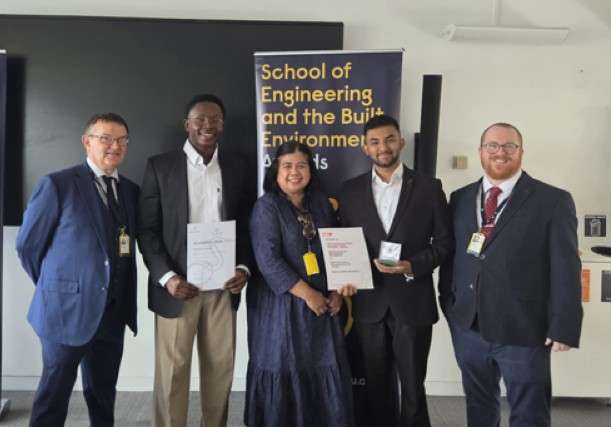
European Technology Development Ltd. (ETD) are proud to have sponsored prizes for some of the best performing 2026 Engineering Graduates of Anglia Ruskin University, UK.

On Monday 13th July 2026 ETD were invited by the University to give the prizes to these students. The picture below shows Dr Sarinova Simanjuntak (in the middle) handing over the prize certificates, on behalf of ETD, to some of these students.

MIMA-4 Int. Conference on ‘Decarbonisation of Power Generation’ 23-25 June 2025

European Technology Development Ltd. (ETD) – a company based in Surrey (just south of London), are organising an International Conference on the ‘Decarbonisation of Power Generation’ – the use of H2 and other alternative fuels plus nuclear fusion, energy storage and renewables. Due to unfortunate local circumstances, we had to change the dates from April to June 23-25, 2025 and make a slight change in the venue, although still in central London.

This MIMA-4 Conf. (4th in the series of MIMA conferences) also covers Materials, Inspection, Monitoring and Assessment (MIMA) and flexible operation of fossil power plants (both materials and cost issues) used to back-up the intermittent renewables.

It’s our mission to provide you with a great experience, which is the reason why we are also hosting a boat cruise & dinner on Day 2 (24/06/25) from 18:00 PM to 22:00 PM, crusading over the Thames to the beautiful sights of London. You do not want to miss out!

Listen to the contributions from the UK industry, research/ universities/ UK government, Japan, Singapore, Korea, Australia and European countries.

This is a great opportunity for Networking and discovering innovations in power generation.

Conference details at: https://www.etd-consulting.com/event/mima-4-conference/

On-site non-destructive Inspection of GT Blades: Invitation to join a new Group Sponsored Project (GSP)

Preamble

Scanning Force Microscope (SFM) has been developed for the on-site inspection of industrial components to detect and map early stage (nano or micro level) creep, fatigue or corrosion type damage. It is a portable version of the Atomic Force Microscope (AFM) which has been usually used for research purposes. ETD is proud to have it developed for the on-site inspection of industrial plant components where the damage may be too small to resolve by the traditional NDE techniques, for example, the early stage creep cavitation damage in ASME P91 or P92 steels.

GT Blade Inspection

In a recent exploratory phase project ETD discovered and demonstrated the SFM’s in-lab. use for the inspection of Gas Turbine blade pieces to study the gamma prime shape and size development with time thus enabling SFM use for the on-site inspection of GT blades non-destructively.

We are now planning to take this development to the next phase of optimising the SFM image resolution parameters in the lab. tests on full size GT blades followed by on-site inspection of the GT blades and develop relationship parameters between the coarsening of the gamma prime precipitates, their shape and blade condition/ safe remaining life.

Benefits

This 6-month duration investigation should be of huge benefit to the GT blade manufacturers, plant owners/ operators and service providers who will have access to a new and innovative technology and tool that helps to non-destructively examine and assess the condition/ life of GT blades saving them significant costs.

Group Sponsored Project and Cost

Please note that this proposal has been launched as a Group Sponsored Project which means that a number of sponsors will share the cost each contributing a small cost but getting the full results. The actual cost will depend on the number of sponsors that we can obtain but could be between £5,000 to £10,000 GB pounds for each sponsor.

Please click here to see the proposal details.

For more information please write to Dr A Shibli at: ashibli@etd-consulting.com

Please let us know if you would like to contribute an old GT blade for investigation either in the lab or at the site.

Launch of a new powerful Int. Group ‘JUS’ for the assessment of ageing Power & Process plants


ETD together with its collaborators from Japan (KMTL, CRIEPI) and Singapore (CETIM-Matcor) have now put together their knowledge, expertise and over a century of combined experience to offer full power and process plant inspection (using both conventional and recently developed, by the Group, innovative inspection techniques) and life assessment of the critical components of ageing plants.

This new group ‘JUS’ is aiming to provide its unique services internationally.

For more details please click here.

ETD’s three presentations made at MPA Seminar, Stuttgart, Germany, on 8-10 Oct. 2024

We are pleased to provide below ETD’ three presentations made last week (8-10 October 2024) at the MPA Seminar held in Stuttgart, Germany. Please click on the link below to access these presentations:

These cover the following topics:

  • Use of Hydrogen as the Fuel Mix with Natural Gas in CCGTs – Technical and Cost Issues

       Hong-Wei Wang, Ahmed Shibli, European Technology Development (ETD), Leatherhead, Surrey, UK


  • Innovations in Inspection and Monitoring Techniques for High Temperature Plants

       Ahmed Shibli, Rumman Syed, European Technology Development (ETD), Leatherhead, Surrey, UK


  • Power Plant Cost and Performance Analysis When Operating in Base Load and Flexible Operation Modes With Increasing Renewables

        Ahmed Shibli, European Technology Development (ETD), Leatherhead, Surrey, UK

ETD Conculting Logo.